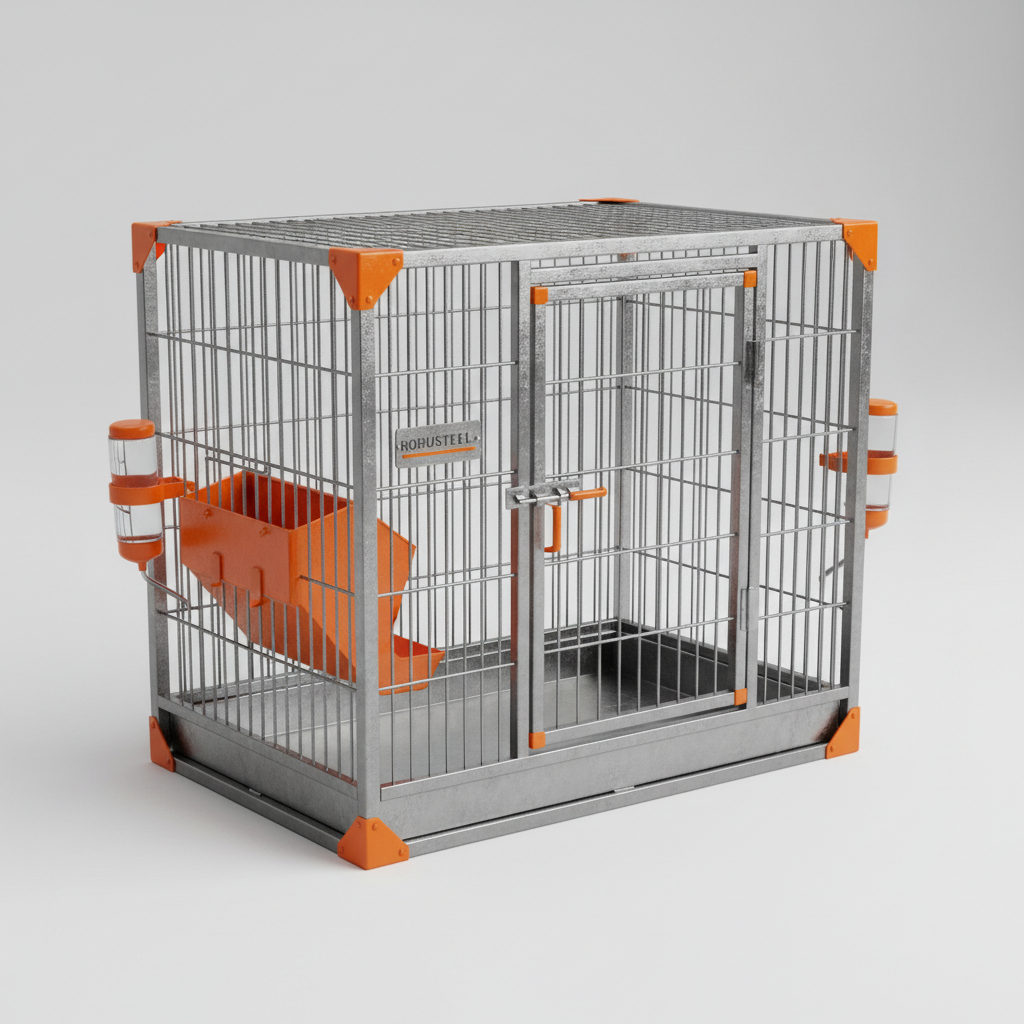
Selecting the right infrastructure for avian livestock is less about the cage itself and more about the systemic integration of nutrition, waste management, and animal welfare. For many commercial operations, the bottleneck in productivity isn't the breed of the bird, but the efficiency of the equipment supporting them.
The modern livestock landscape is shifting toward high-density, automated environments where the precision of feed delivery and the stability of the housing directly correlate with the feed conversion ratio (FCR). This has led to a rigorous re-evaluation of how farmers vet their poultry cage suppliers to ensure long-term operational viability.
Beyond the housing structures, the integration of feed processing—specifically the grinding and mixing stages—is where the highest gains in animal health and growth are realized. This article examines the critical intersection of housing and nutrition systems in professional poultry farming.


Automation in livestock farming has evolved from simple mechanical feeders to integrated ecological systems. The primary objective is the reduction of human error and the minimization of labor costs, which are traditionally the highest overheads in poultry production.
Modern systems now integrate environmental control and feeding schedules into a single loop. When farmers seek poultry cage suppliers, they are increasingly looking for partners who can provide not just the cages, but the surrounding automation—from slaughter equipment to breeding automation—ensuring a seamless flow from hatch to market.
The efficacy of a livestock diet depends entirely on homogeneity. Inconsistent mixing leads to "nutrient pockets," where some birds receive excess supplements while others suffer from deficiencies, resulting in uneven growth rates across the flock.
Advanced feed processing machines address this through dynamic tumbling action. By utilizing a rotational and throwing structure, materials are forced into a constant tumbling motion, moving up and down within the mixer to ensure that every grain is coated with the necessary additives. A strategically staggered left-and-right configuration further accelerates the blending process, reducing the time required to achieve a uniform mixture.
Furthermore, the grinding stage is critical for digestibility. By reducing grain size to a specific mesh, the surface area for enzymatic action increases, which directly enhances nutrient absorption and overall animal health.
Housing and nutrition cannot be managed in silos. A high-density cage system increases the risk of stress and disease, which can only be mitigated by a precise, high-quality diet that supports the immune system.
Operational efficiency in poultry farming is a product of the synergy between Environmental Control Equipment and Feed Processing Machines; neither can maximize ROI without the other.
For example, if a farmer invests in premium automated cages but uses a subpar mixer, the resulting nutrient imbalance will negate the benefits of the housing. Conversely, high-quality feed in a poorly ventilated cage leads to respiratory stress, hindering the bird's ability to convert that feed into mass.
When evaluating feed mixer and grinder units, technical parameters must be aligned with the herd size. Power requirements (ranging from 3KW to 5.5KW for mixers) and production capacity (up to 2000kg/h) are the primary drivers of efficiency.
The following index provides a conceptual comparison of how different technical factors impact the overall performance of the feed preparation process.
In a typical mid-sized industrial setting, a farmer may manage several thousand birds. In this scenario, the priority is the balance between production volume and energy efficiency. Utilizing a mixer with a compact footprint and low noise emissions allows for the installation of the processing unit closer to the housing, reducing material transport time.
For larger enterprises, the focus shifts to durability and maintenance. The ability to easily clean residual materials from the mixer is not just a convenience—it is a biosecurity requirement. Preventing cross-contamination between different feed batches is essential to avoid the spread of nutritional imbalances or pathogens across different age groups of the flock.
The industry is moving toward "Zero Emission" and "Energy Lean" manufacturing. Equipment that combines multiple functions—such as grinding and mixing in one operation—is becoming the standard for cost-effective farm productivity.
We are also seeing a rise in the demand for customizable equipment. Since every farm has a different power source (Electric vs. PTO) and different space constraints, the ability to customize the crushing chamber width or screen mesh size is becoming a key competitive advantage for manufacturers.
Furthermore, the integration of IoT sensors into feed processing and cage systems will allow for real-time monitoring of feed consumption, enabling farmers to adjust the mix dynamically based on the actual growth stage of the birds.
Choosing the right equipment requires a trade-off analysis between initial capital expenditure (CAPEX) and long-term operational expenditure (OPEX). A cheaper mixer that consumes more energy and requires frequent maintenance will quickly exceed the cost of a high-efficiency model.
Farmers should evaluate poultry cage suppliers and equipment manufacturers based on their ability to provide a "one-stop service," including design, customization, and after-sale support. This reduces the risk of integration failures between different machine brands.
The following framework outlines the key considerations when selecting feed processing equipment based on different farm scales.
| Farm Scale | Priority Factor | Recommended Power | Key Requirement |
|---|---|---|---|
| Small-Scale | Compactness | 3KW Mixer | Low Noise / Ease of Use |
| Mid-Scale | Throughput | 4KW Mixer | Uniform Mixing Speed |
| Large-Scale | Durability | 5.5KW Mixer | High Production (kg/h) |
| Industrial | Automation | Custom Integrated | Zero Dust / Energy Lean |
| Diversified | Versatility | Multi-function | Multi-application use |
| Export-Oriented | Certification | Standardized | ISO9001 / Quality Assurance |
A tumbling mixer uses a rotational and throwing structure to create a vertical and horizontal movement of materials, which is often more effective for fragile ingredients and prevents the "clumping" sometimes seen in ribbon blenders. The staggered configuration in tumbling mixers ensures that materials move up and down constantly, promoting a more rapid and uniform blend without over-processing the feed.
The ideal mesh size depends on the age of the birds and the type of feed. For starters, a finer grind is necessary to improve digestibility and nutrient absorption. For mature layers or broilers, a slightly coarser grind may be preferred. Professional grinders offer various screen mesh sizes (e.g., 131mm to 200mm options) to allow farmers to customize the texture based on their specific livestock needs.
Determine the total daily feed requirement based on your herd size. If you are processing under 1000kg per hour, a 3KW mixer is typically sufficient. For larger operations requiring 1500-2000kg/h, you should move to a 4KW or 5.5KW motor. Consider not just the mixer power, but also the grinder power (7.5KW to 15KW) to ensure the entire production line is balanced and no bottlenecks occur.
For livestock equipment, high-quality steel alloys and stainless steel are preferred due to their resistance to corrosion from animal waste and feed additives. Equipment that features a robust, easy-to-clean structure ensures a longer service life and simplifies the maintenance process, which is critical for preventing bacterial buildup and ensuring food safety.
Yes, high-quality feed mixers are designed to be versatile and multipurpose. They can be used for poultry, pigs, and rabbits, provided the ingredients are similar in density. The key is the ability to thoroughly clean the residual materials between batches to avoid cross-contamination of species-specific supplements.
Dust emissions in a feed mill can lead to respiratory issues for both the workers and the animals. Moreover, excessive dust represents a loss of fine nutritional particles (the most nutrient-dense part of the feed). Equipment designed for zero dust emissions is more environmentally friendly and ensures that the maximum amount of prepared feed actually reaches the birds.
Optimizing poultry production is a balancing act between the physical environment of the cage and the chemical precision of the feed. By investing in equipment that prioritizes homogeneity and automation, farmers can significantly reduce waste and improve the growth trajectory of their flock.
The ultimate goal for any professional operation is a streamlined, integrated system where housing, environmental control, and feed processing work in unison. Choosing suppliers who understand this systemic relationship is the most reliable path toward sustainable agricultural growth.